

 Banking
 Insurance
 Credit Unions


 Professional Services
 Consulting & Advisory
 Legacy Migration


 Insights
 Whitepapers
 FAQs
 Brochures
 E-Books
 Glossary
 Case Studies
 Events & News
 About Us
 Information Security
 Leadership
 Careers
 Partner Program
 FCI Cares
 9 Pages
 Total View : 432 |

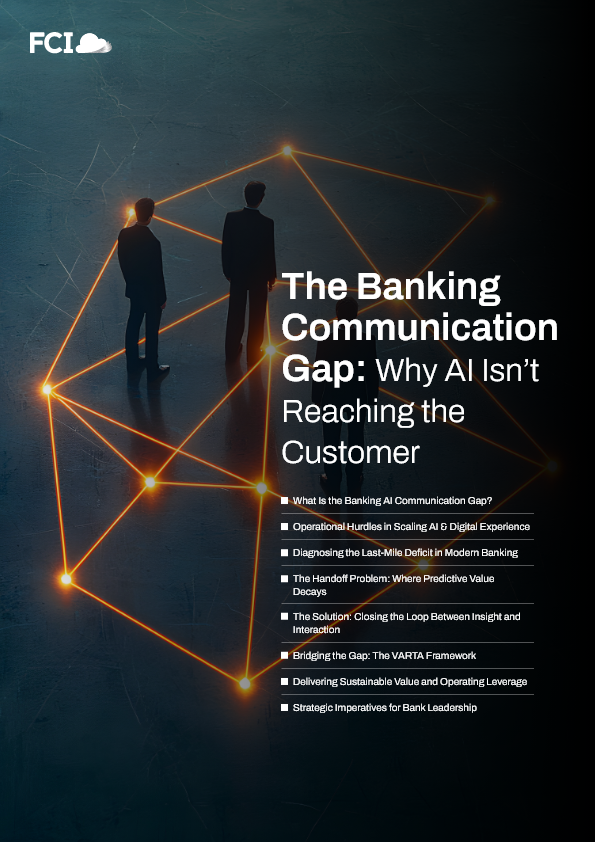
The real cost of poor customer communication is loyalty.
Customers notice when a bank gets it right, yet letters remain one of the least modernized parts of banking. Many banks still depend on paper, locked in millions of dollars in mailing costs.
Meanwhile, their AI can already read intent, predict churn, and spot cross-sell opportunities. But too often those insights stall before they reach the customer. The model knows the right moment, and the message arrives late, or not at all.
The challenge is no longer generating intelligence. It’s turning it into timely, relevant, compliant communication on every channel, at a lower cost.
This paper explains why the gap persists and how to close it.
What You’ll Learn
- Why strong models don’t always deliver better experiences
- Where value is lost between inference and delivery
- How batch-based legacy systems limit real-time engagement
- Why compliance belongs inside communication execution
- How event-driven communication improves relevance
- How orchestration connects data, AI, channels, and journeys
- How an insights-led approach supports retention, conversion, and trust
Is Your Bank Ready to Close the Gap?
Test how well your institution connects intelligence to engagement:
- How long does AI insight take to become customer communication?
- Where do approvals or channel handoffs cause delays?
- Can your communication rules adapt to real-time context?
- Is compliance built into the execution layer?
- Can you tie outcomes to conversion, retention, and cost to serve?