


 Banking
 Insurance
 Credit Unions


 Professional Services
 Consulting & Advisory
 Legacy Migration

 Insights
 Whitepapers
 FAQs
FAQs Brochures
 E-Books
 Glossary
  Case Studies
 Events & News
 About Us
 Information Security
 FCI Cares
 Leadership
 Careers
 Partner Program
 Current Openings

TL:DR
In modern banking, every customer notification is part of the transaction. Whether it’s an OTP, payment confirmation, or balance update, customers expect instant, reliable delivery. When notifications fail, transactions are disrupted, trust declines, support costs increase, and compliance becomes harder to demonstrate.

A multi-channel fallback strategy keeps critical alerts moving with intelligent channel failover across SMS, WhatsApp, push notifications, and email.
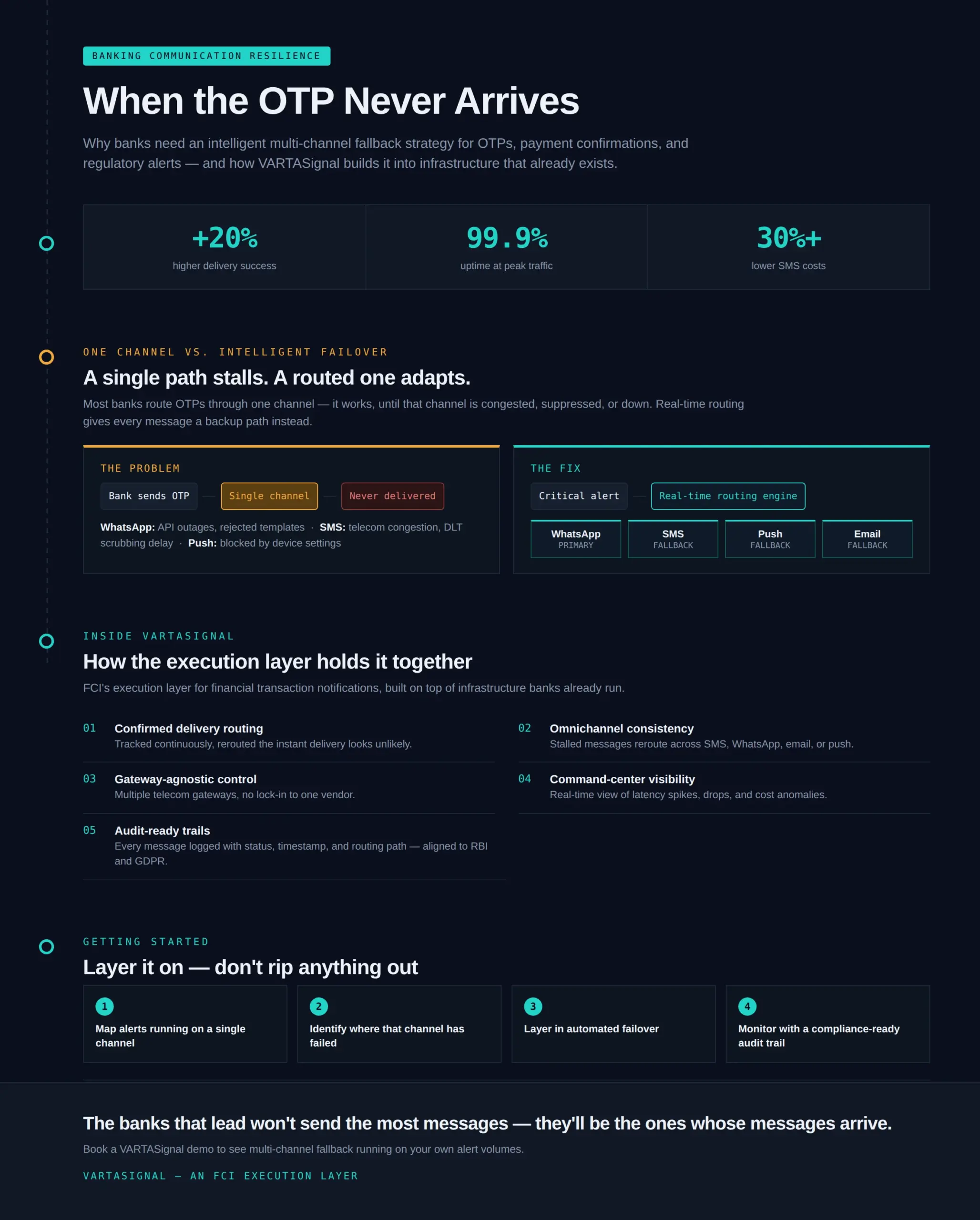
VARTASignal embeds this capability into a bank’s existing messaging infrastructure, helping achieve up to 20% higher delivery success, 99.9% uptime, and over 30% lower SMS costs, even during peak traffic and gateway outages.
The Core Problem?
Most banks still route these critical alerts through a single messaging channel or provider. That works fine on a normal day. The moment that channel slows down, gets suppressed, or goes dark, the transaction behind it stalls too, along with customer trust, support costs, and regulatory standing.
This is where a multi-channel fallback strategy comes in. Rather than betting an entire notification on one channel, it builds in automated alert routing and channel failover, so a message can move to SMS, WhatsApp, push, or email the moment its first path is at risk.
In this article, we will unpack why single-channel dependency is a bigger risk than most banks realize, what a real multi-channel fallback strategy is built on, and how VARTASignal operationalizes it inside existing banking infrastructure. Let’s start with the hidden cost of relying on one channel.
The Hidden Cost of a Single Point of Failure
Banks have invested heavily in modernizing digital payments, mobile banking, and customer onboarding. Yet the communication layer behind these journeys is often still tied to a single messaging channel or provider. That looks efficient on paper, but it quietly concentrates risk in one place.
Communication failures rarely come from a single source. A WhatsApp notification can fail because of an API outage or a rejected template. An OTP sent by SMS can be delayed by telecom congestion. A push notification can simply never appear because of a device setting, while regulatory checks such as India’s TRAI-mandated Distributed Ledger Technology (DLT) scrubbing add latency the bank cannot control directly.
On their own, these look like routine hiccups. Together, they add up to stalled transactions, repeat attempts, heavier contact center volumes, and compliance gaps that surface the moment a regulator asks for proof of delivery. The real cost is rarely the missed notification itself. It is the operational friction that follows it.
As transaction volumes keep growing, a single communication path is a risk modern banking can no longer carry.
Why Communication Resilience Has Become a Competitive Advantage
Digital banking has trained customers to expect real time responses, whether they are authenticating a payment or checking an account update. Regulators expect the same speed on the transparency side, asking banks to show exactly how a notification was routed, delivered, and monitored across its full lifecycle.
That shift has changed how banks evaluate their communication infrastructure. It is no longer judged on cost alone. It is increasingly judged on what it protects and enables, from customer trust to revenue continuity.
Communication resilience has become a strategic capability, one that shapes customer trust, operational efficiency, and regulatory confidence at the same time.
What Is an Intelligent Multi-Channel Fallback Strategy?
An effective multi-channel fallback strategy rests on one simple rule: every critical notification needs a backup path to the customer. This removes a bank’s dependency on any single communication channel. Instead of routing every OTP or alert through one fixed path, a modern notification setup continuously checks delivery conditions and decides, in real time, which channel gives the message the best chance of landing.
How it plays out in practice:
- If a WhatsApp notification cannot get through, intelligent alert routing can trigger SMS fallback
- If SMS runs into congestion, the message can move to a push notification or email fallback
- Throughout, channel failover keeps monitoring delivery outcomes in real time, so the bank can react before the customer ever notices a delay.
The goal is not to send more messages. It is to make sure every critical message reaches its recipient, with the reliability, visibility, and governance banks are expected to demonstrate today.
Closing the Execution Gap
Designing a multi-channel fallback strategy is the easy part. Operationalizing it across millions of customer interactions is where most attempts run into trouble.
Every banking notification must be evaluated against several moving variables in real time: channel availability, vendor performance, message priority, customer preference, and regulatory requirement.
As communication ecosystems get more distributed, keeping execution consistent across SMS fallback, WhatsApp notifications, push notifications, and email fallback gets significantly harder to manage by hand.
Without centralized visibility, the failure mode is not just a missed notification. Banks end up with fragmented routing decisions, inconsistent customer experiences, thin audit trails, and rising operational overhead, exactly as transaction volumes keep climbing.
Closing that gap turns communication from a reactive delivery process into a strategic capability: uninterrupted customer journeys, stronger regulatory standing, less operational complexity, and a consistent experience across every channel. Getting there takes more than adding channels. It takes an execution layer built to orchestrate alert routing, channel failover, governance, and real-time delivery decisions across the infrastructure a bank already has.
Why Fallback Has Become a Boardroom Conversation
Customer expectations have evolved, with speed, reliability, and transparency now defining every banking interaction. As a result, every transaction depends not only on secure processing but also on timely, dependable communication that builds confidence and trust throughout the customer journey.
As banks continue investing in digital transformation, communication resilience needs a seat at that table, not a footnote to it. Institutions that build in multi-channel fallback, intelligent alert routing, and automated channel failover are better placed to protect customer trust, satisfy regulators, and keep banking experiences running, even when individual channels or providers go down.
VARTASignal brings that shift to life by combining execution intelligence, governance, and resilience into a single execution layer. The payoff is not just a better delivery rate. It is stronger customer relationships, more operational confidence, and a communication setup built for where digital banking is headed.
How VARTASignal Builds Failover into the Infrastructure
This is the exact problem VARTASignal, FCI’s execution layer for financial transaction notifications, was built to solve. It treats transactional messaging as a governed banking function, not a bundle of disconnected tools.
Rather than adding another messaging channel to the stack, VARTASignal operationalizes the capabilities above as a single execution layer, giving banks control over exactly how OTPs, transaction confirmations, and regulatory notifications are prioritized, routed, delivered, and audited, without disturbing core systems.
Banks running critical alerts through VARTASignal have reported delivery success rates improving by up to 20%, uptime holding at 99.9%, and SMS costs dropping by 30% or more, even during peak load and gateway disruptions.
In practice, that looks like:
- Confirmed delivery through real-time routing. Every message is tracked continuously and rerouted the instant it looks unlikely to land.
- Omnichannel consistency. If a message stalls or fails on one channel, VARTASignal reroutes it across SMS, WhatsApp, email, or push notification, without anyone stepping in.
- Gateway-agnostic, bank-owned control. Banks connect multiple telecom gateways and switch dynamically between them, rather than being locked into one vendor.
- A command-center view. Real-time visibility into latency spikes, delivery drops, and cost anomalies, before they ever reach a customer complaint.
- Full, audit-ready trails. Every message logged with delivery status, timestamp, and routing path, aligned with RBI, GDPR, and other financial regulations, ready for compliance review at any time.
Getting Started Without Ripping Out What Already Works
Adopting a multi-channel fallback strategy does not mean replacing existing infrastructure. Whether that is SMS fallback, email fallback, or push escalation, it means layering intelligence on top of what is already there:
- Map which critical alerts (OTPs, payments) currently run on a single channel.
- Identify where that channel has failed before, whether from congestion, suppression, or API downtime.
- Layer in automated failover across push, WhatsApp, SMS, and email.
- Monitor delivery in real time and keep the audit trail compliance-ready from day one.
The New Baseline for Banking Reliability
Reliability is no longer a differentiator for financial institutions. It is the baseline that customers, regulators, and boards now expect. A multi-channel fallback strategy reduces “the message didn’t arrive” from a routine risk to a rare exception, supported by an audit trail that holds up under scrutiny.
The banks that lead in the next decade will not be defined by how many messages they send, but by how consistently those messages arrive.