


 Banking
 Insurance
 Credit Unions


 Professional Services
 Consulting & Advisory
 Legacy Migration

 Insights
 Whitepapers
 FAQs
FAQs Brochures
 E-Books
 Glossary
  Case Studies
 Events & News
 About Us
 Information Security
 FCI Cares
 Leadership
 Careers
 Partner Program
 Current Openings

A Customer Intelligence Platform (CIP) helps banks convert customer data into timely, personalized action. For communication monetization, the use case is using customer intelligence to turn service and transactional communication into growth opportunities. An AI-driven intelligence layer identifies intent, recommends next-best actions, coordinates channels, respects consent, and measures outcomes.
Banks have invested heavily in AI propensity engines, churn algorithms, real-time risk scores. Yet 58% of banking clients expect immediate, real-time responsiveness, and only 23% feel their bank meets that bar. Meanwhile, 89% cite rigid, generic communication as a persistent pain point, and 31% have stopped doing business with a bank after repeated poor communication experiences.
The disconnect between AI capability and customer experience is an execution problem: legacy systems, siloed data, and batch workflows erode real-time insights before they reach customers.
A customer intelligence platform addresses this gap by unifying these signals, interpreting context, recommending next-best actions, and measuring outcomes in closed-loop fashion. The result: banks can turn service and transactional communications into growth opportunities driving higher conversion, better cross-sell relevance, lower churn, and clearer ROI attribution.

The State of Banking personalization: Investment without Impact
Banks may build formidable analytical capabilities over the past decade. AI has transitioned from pilot projects to core infrastructure across marketing, and service. Institutions can now predict churn, surface cross-sell opportunities, and assess risk in milliseconds.
Despite this investment, customer experience remains largely reactive. Insights sit in data lakes, compliance queues, or batch workflows. By the time a message is approved and delivered, the moment of intent has often passed. The commercial value of predictive insights decays rapidly when execution requires days of template assembly, approvals, and batch runs.
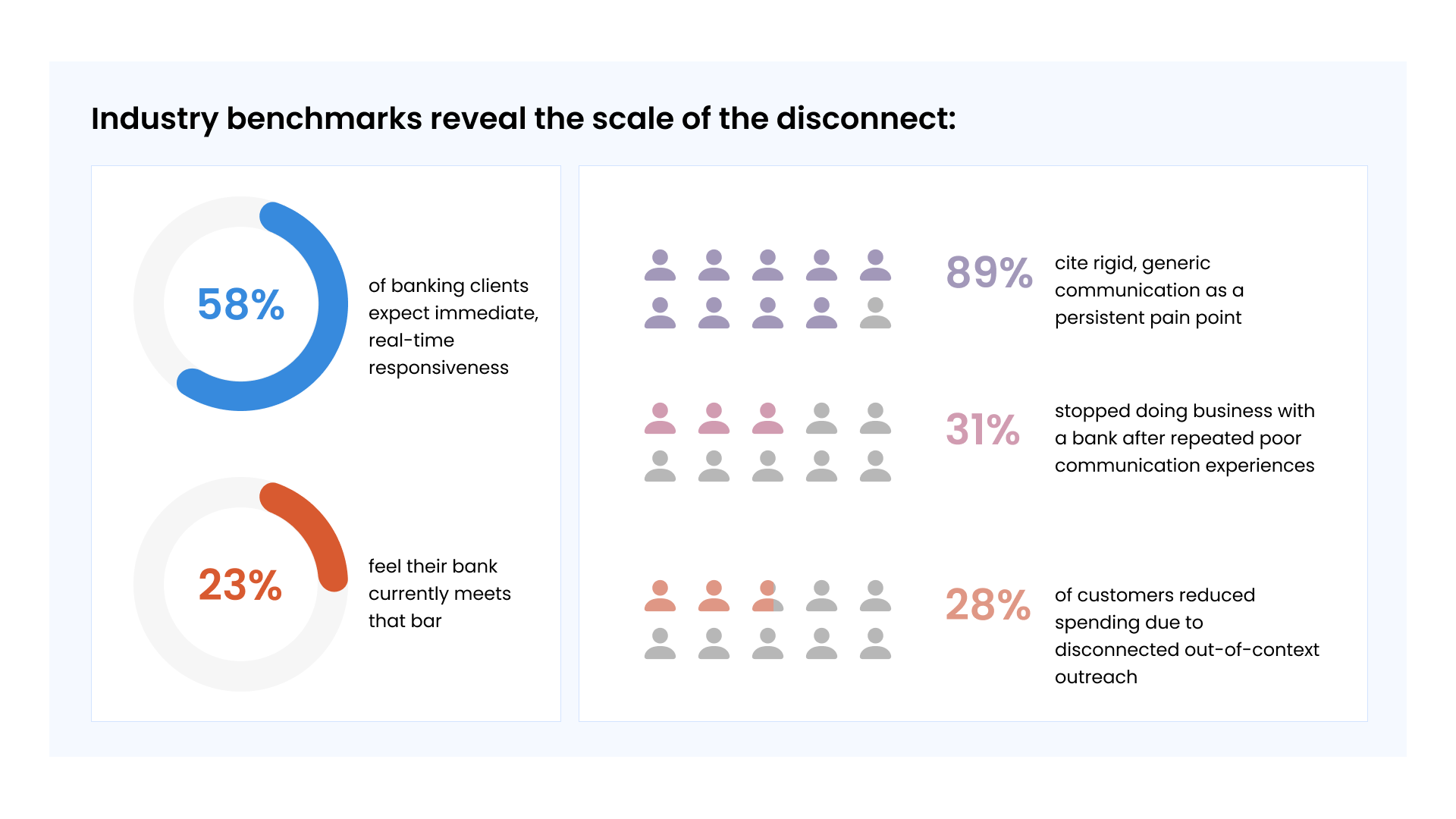
Industry benchmarks reveal the scale of the disconnect:
- 58% of banking clients expect immediate, real-time responsiveness
- Only 23% feel their bank currently meets that bar
- 89% cite rigid, generic communication as a persistent pain point
- 31% stopped doing business with a bank after repeated poor communication experiences
- 28% of customers reduced spending due to disconnected out-of-context outreach
Banks can model customer behavior, but many still cannot act on it quickly, consistently, and compliantly across channels. The constraint is no longer intelligent, it is execution. This execution gap directly erodes customer satisfaction, dilutes return on technology investments, and creates competitive vulnerability as fintechs and neobanks raise customer expectations.
Six Structural Barriers Preventing Banks from Scaling Personalization
- Legacy Communication Infrastructure
Most banks rely on Customer Communication Management platforms built for static templates, monthly batch cycles, and fragmented channels. These systems were designed for compliance and cost efficiency – not real-time, context-aware engagement.
Legacy infrastructure introduces latency between insight and delivery. When an AI model identifies a high-value opportunity – salary credit, spending surge, application drop-off—the insight sits in queues while templates are assembled and approvals are sought. By the time the message arrives, the customer has already acted elsewhere. This latency converts predictive advantage into competitive disadvantage.
- Insights Generated but Not Activated
Predictive insights frequently remain trapped within data lakes, compliance queues, and scheduled marketing batches. Banks generate tens of thousands of automated interactions monthly, yet intelligence rarely reaches customers as context-aware messages when it matters most.
The commercial value of AI investment is not realized. Banks pay for sophisticated models but capture only a fraction of their potential ROI. Meanwhile, customers experience communication that feels generic and reactive – undermining trust and loyalty despite heavy technology spend.
- Campaigns Designed but Not Delivered in Real Time
Complex processes like KYC onboarding remain major operational pain points – not because of computational limits, but because legacy platforms cannot convert complex behavioral data into fast, auditable, and compliant customer interactions.
Customer journeys stall at critical moments. Application drop-offs increase. Conversion rates suffer. Relationship managers call without context. Customers abandon processes they started, and banks lose revenue they could have captured with timely, relevant intervention.
- Compliance Enforced but Not Embedded
Compliance is treated as a final gate, not an embedded control. This creates delays and friction that decay the value of real-time insights.
Banks face a false trade-off between speed and governance. They assume real-time engagement requires compliance shortcuts. In reality, modern orchestration platforms can embed consent, fatigue management, do-not-disturb logic, and audit trails into the execution layer – enabling both speed and governance simultaneously.
- Channels Available but Not Orchestrated
Different channels use different tools, data, and rules. SMS, email, WhatsApp, app notifications, contact center prompts, and RM tasks operate in silos.
Customers receive inconsistent experiences. A customer may get a loan offer after raising a complaint about fees. An RM may call without knowing the customer already completed the action online. A campaign may continue after the customer has declined or converted. This fragmentation erodes trust and increases opt-out rates.
- Organizational Misalignment
Too many banks treat personalization as either a marketing initiative or an analytics initiative. It needs to be both and neither. It needs to be a joint business initiative with shared accountability.
Initiatives remain subscale. Analytics teams build models that marketing cannot operationalize. Marketing runs campaigns that analytics cannot measure. Technology investments do not translate into business outcomes. Without shared accountability and integrated teams, personalization efforts fragment and underperform.
What A Customer Intelligence Platform Actually Solves
A customer intelligence platform is a decision-making layer that sits between data and customer touchpoints. It takes signals—salary credits, card declines, loan drop-offs, deposit maturities, app logins, service complaints—and translates them into actions.
The platform operates in four stages:
- Signal Unification
Bring together data from core banking, CRM, cards, loans, digital channels, service platforms, campaign tools, and customer data platforms.
- Context Interpretation
Apply rules, models, and behavioral patterns to understand what each signal means. A dormant account isn’t just inactive—it’s a churn risk or reactivation opportunity.
- Action Recommendation
Based on eligibility, intent, value, risk, consent, and channel preference, recommend or trigger the next best action. This could be a personalized offer, a service intervention, an RM task, or a journey nudge.
- Closed-Loop Learning
Measure the outcome. Did the customer convert? Did they ignore the message? Did they opt out? Feed that learning back into future decisions.
The Business Case: What’s at Stake
When banks shift from static campaigns to intelligence-driven engagement, the impact shows up across measurable dimensions:
- Higher conversion rates because offers align with active intent
- Better cross-sell relevance because recommendations reflect real behavior
- Lower customer drop-off because interventions happen before churn
- Improved deposit retention because maturity moments are anticipated
- Faster dormant customer reactivation because signals trigger timely nudges
- Stronger RM productivity because tasks are prioritized by value and readiness
- Reduced campaign wastage because messages go only to receptive audiences
- Clearer ROI attribution because every action is measured and learned from
This is communication monetization in action is about making every message count.
KPIs That Actually Matter
Track these instead, if you’re measuring success by open rates alone:
- Conversion rate: Did the customer take the desired action?
- Journey completion rate: Did they finish the intended journey?
- Product uptake: Did they adopt the recommended product?
- Offer acceptance: Did they say yes?
- Dormant customer reactivation: Did inactive customers re-engage?
- Churn reduction: Did at-risk customers stay?
- RM contact productivity: Did relationship manager tasks lead to outcomes?
- Campaign cost per conversion: What did each conversion cost?
- Incremental revenue: What new revenue did intelligence-driven engagement create?
- Consent adherence: Are you respecting preferences and regulations?
- Channel preference performance: Which channels drive best outcomes?
CIP – Core Capabilities & Architecture
VARTASense is an AI-driven customer intelligence and engagement layer that translates banking data into real-time decisioning. It operationalizes a four-stage growth model to move banks beyond passive dashboards and into active customer management:
- Intelligence & Segmentation
Contextual Micro-Segmentation: Converts broad customer categories into dynamic, context-aware micro-groups using real-time behavioral signals.
Consent-First Governance: Embeds regulatory compliance, customer preferences, and privacy rules directly into data ingestion and delivery.
- Intent & Decisioning
Next-Best Action Engine: Evaluates intent, eligibility, and customer value to surface the most relevant action in the moment.
Persona-Aware Nudges: Tailors messaging to individual financial behaviors, risk profiles, and life-stage triggers.
- Orchestration & Integration
Multichannel Execution: Synchronizes delivery across email, SMS, WhatsApp, push notifications, relationship manager (RM) workflows, and digital journeys.
Core & CRM Integration: Hooks natively into existing core banking engines and CRM stacks without requiring complete infrastructure overhauls.
- Optimization & Value Capture
Closed-Loop Learning: Ingests customer responses to continuously train and refine predictive models.
ROI Attribution: Delivers real-time performance analytics to reveal what drives growth, what fails, and why.
Why It Matters
VARTASense bridges the disconnect between enterprise data and real-time execution. By embedding intelligence directly into operational workflows, financial institutions can:
Convert routine touchpoints into growth engines: Transform standard transaction alerts and service notifications into personalized cross-sell and retention moments.
Shift from campaign volume to value creation: Move away from generic mass marketing toward outcome-based customer engagement.
Act inside the decision window: Deliver contextually relevant offers while customer intent is still active.
Conclusion: Strategic Value & Business Impact
VARTASense bridges the disconnect between enterprise data and real-time execution. By embedding intelligence directly into operational workflows, financial institutions can:
Convert routine touchpoints into growth engines: Transform standard transaction alerts and service notifications into personalized cross-sell and retention moments.
Shift from campaign volume to value creation: Move away from generic mass marketing toward outcome-based customer engagement.
Act inside the decision window: Deliver contextually relevant offers while customer intent is still active.