


 Banking
 Insurance
 Credit Unions


 Professional Services
 Consulting & Advisory
 Legacy Migration

 Insights
 Whitepapers
 FAQs
FAQs Brochures
 E-Books
 Glossary
  Case Studies
 Events & News
 About Us
 Information Security
 FCI Cares
 Leadership
 Careers
 Partner Program
 Current Openings

A salary credit offer is a personalized action – a loan offer, savings nudge, credit card recommendation, or RM follow-up – that a bank triggers the moment it detects a salary credit event, rather than days later through a generic campaign. Acting on this signal in real time, with consent, is what separates modern customer intelligence from traditional segmentation.

TL;DR
- Salary credit is one of the clearest liquidity signals a bank receives – and one of the most time-sensitive.
- Static, batch-based campaigns miss the moment; real-time next-best-action engines don’t.
- A working model needs four stages: unify signals, interpret intent, recommend an action, measure the outcome.
- Personalization must be coordinated across channels and consent-aware, not just automated.
- Platforms like VARTASense operationalize this as micro-segmentation, next-best-action logic, and closed-loop learning.
What “salary credit offer” means for banks
For a bank, a salary credit offer isn’t a single product – it’s a decision made at the moment a salary credit is detected. That decision could be a personal loan offer, a wealth or savings nudge, a credit card upgrade, a relationship manager (RM) task, or simply a well-timed piece of product education.
The reason this matters: salary credit is one of the few events that reliably indicates fresh liquidity. A customer who has just been paid is more receptive to a relevant offer than the same customer three weeks later. Banks that can recognize this moment – and respond to it appropriately – capture value that batch campaigns typically miss.
This is the foundation of the broader Salary-Credit Journeys area: using lifecycle events (salary credit, loan inquiry, card decline, deposit maturity, dormancy) as triggers for timely, relevant next steps.
The core use case: salary-credit-based offers, savings nudges, credit card recommendations, and RM follow-ups
Static campaigns struggle here because a customer moment can appear and disappear within days:
- A salary credit signals fresh liquidity – a window for a personal loan offer or a wealth product nudge.
- A loan application drop-off signals hesitation or a missing document – a window for a service intervention.
- A dormant account signals churn risk – a window for reactivation.
- A card decline signals friction – a window for a service-led, not sales-led, message.
- A deposit maturity signals a retention decision point – a window for a renewal or upgrade offer.
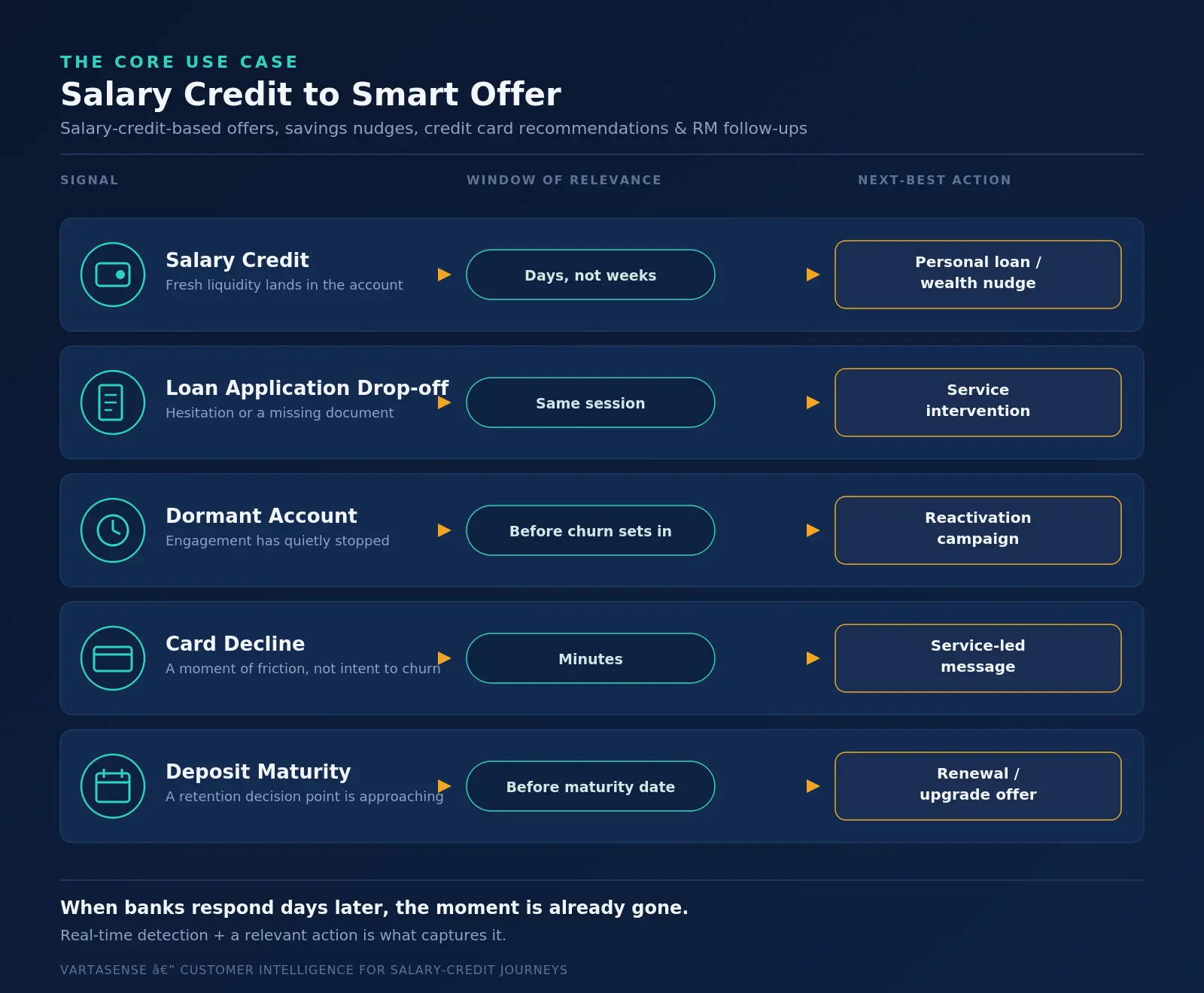
When a bank responds to these signals days later with a one-size-fits-all campaign, the moment has usually passed. A real-time intelligence layer detects the signal, interprets the context, and recommends the next best action while it’s still relevant.
Moving from data to next-best action
A practical customer intelligence model connects four stages:
- Unify signals – pull relevant data from core banking, CRM, cards, loans, digital channels, service platforms, and campaign tools into one view.
- Interpret intent – apply rules, models, and behavioral patterns to understand what the signal actually means for this customer.
- Recommend the next action – weigh eligibility, intent, value, risk, consent, and channel preference to decide what should happen next.
- Measure and learn – feed the outcome back into the model so the next decision is better than the last.
This is the practical difference between having customer data and acting on it. Data only becomes useful once it drives something specific, timely, and measurable.
How personalization should work across channels
Good banking personalization is coordinated – not louder. A few ground rules:
- A customer who just raised a complaint shouldn’t receive an unrelated offer.
- An RM shouldn’t call about something the customer already completed online.
- A campaign should stop the moment a customer converts or declines.
This requires orchestration across SMS, email, WhatsApp, app notifications, contact center scripts, RM task queues, and in-app journeys – all pointed at the same goal: the right message, on the right channel, at the right moment, with consent.
For regulated institutions, this also has to be trust-aware. Consent, channel preference, product suitability, and communication governance aren’t optional add-ons — they’re what makes the engagement defensible. The goal isn’t more messages; it’s messages that are easier to justify and more likely to be welcomed.
Business impact for banks
Salary credit events are a practical entry point for this kind of engagement because they’re frequent, predictable, and tied to genuine intent – a customer who has just been paid is a customer worth talking to about a loan, a savings goal, or an investment option.
Done well, this approach typically improves:
- Conversion and cross-sell relevance
- Deposit retention and RM productivity
- Reactivation speed for dormant customers
- Campaign efficiency (less wasted spend, clearer ROI attribution)
- Customer experience, since offers feel timed and relevant rather than generic
KPIs banks should track
To know whether a salary-credit intelligence model is working, track:
- Conversion rate and offer acceptance rate
- Click-through and journey completion rate
- Product uptake by offer type
- Dormant customer reactivation rate
- Churn reduction
- RM contact productivity
- Campaign cost per conversion and incremental revenue
- Consent adherence and channel preference performance
Just as important: track what doesn’t work. Ignored messages, repeated drop-offs, and channel opt-outs are signals too — feeding them back into the model is what creates closed-loop learning, where every cycle improves the next one.
How VARTASense supports the journey
VARTASense is built as an AI-driven customer intelligence and engagement layer for banks that need to move past broad segmentation and static campaigns toward real-time, persona-aware, measurable engagement.
In practice, that means:
- Micro-segmentation beyond broad demographic buckets
- Next-best-action recommendations tied to live signals like salary credit
- Persona-aware nudges across savings, credit, and wealth products
- Multichannel orchestration so channels don’t compete or duplicate
- Consent-first delivery built into the decisioning layer, not bolted on after
- CRM and core banking integration for a unified signal view
- Closed-loop learning so outcomes continuously refine future decisions
- ROI visibility so marketing and RM teams can see what’s working
Conclusion
Banking growth increasingly depends on how well institutions act on the customers they already have – not just how many new campaigns they run. A salary credit is a small, frequent, high-signal moment. Recognizing it and responding with a relevant, consented, well-timed action is what separates modern customer intelligence from a dashboard that only reports what already happened.
With VARTASense, banks can move from dashboards to decisions, from segments to individual journeys, and from campaign activity to measurable customer growth.