


 Banking
 Insurance
 Credit Unions


 Professional Services
 Consulting & Advisory
 Legacy Migration

 Insights
 Whitepapers
 FAQs
FAQs Brochures
 E-Books
 Glossary
  Case Studies
 Events & News
 About Us
 Information Security
 FCI Cares
 Leadership
 Careers
 Partner Program
 Current Openings

Real-time card alerts are instant, event-triggered notifications banks send to customers when something happens on their card – activation, a declined transaction, a block or unblock, a purchase, a chargeback, or a repayment due date. Delivered through SMS, push, email, WhatsApp, or in-app channels, these alerts give cardholders immediate confirmation or warning, which reduces fraud exposure, cuts support call volume, and builds trust in the bank’s digital experience.

Key Takeaways
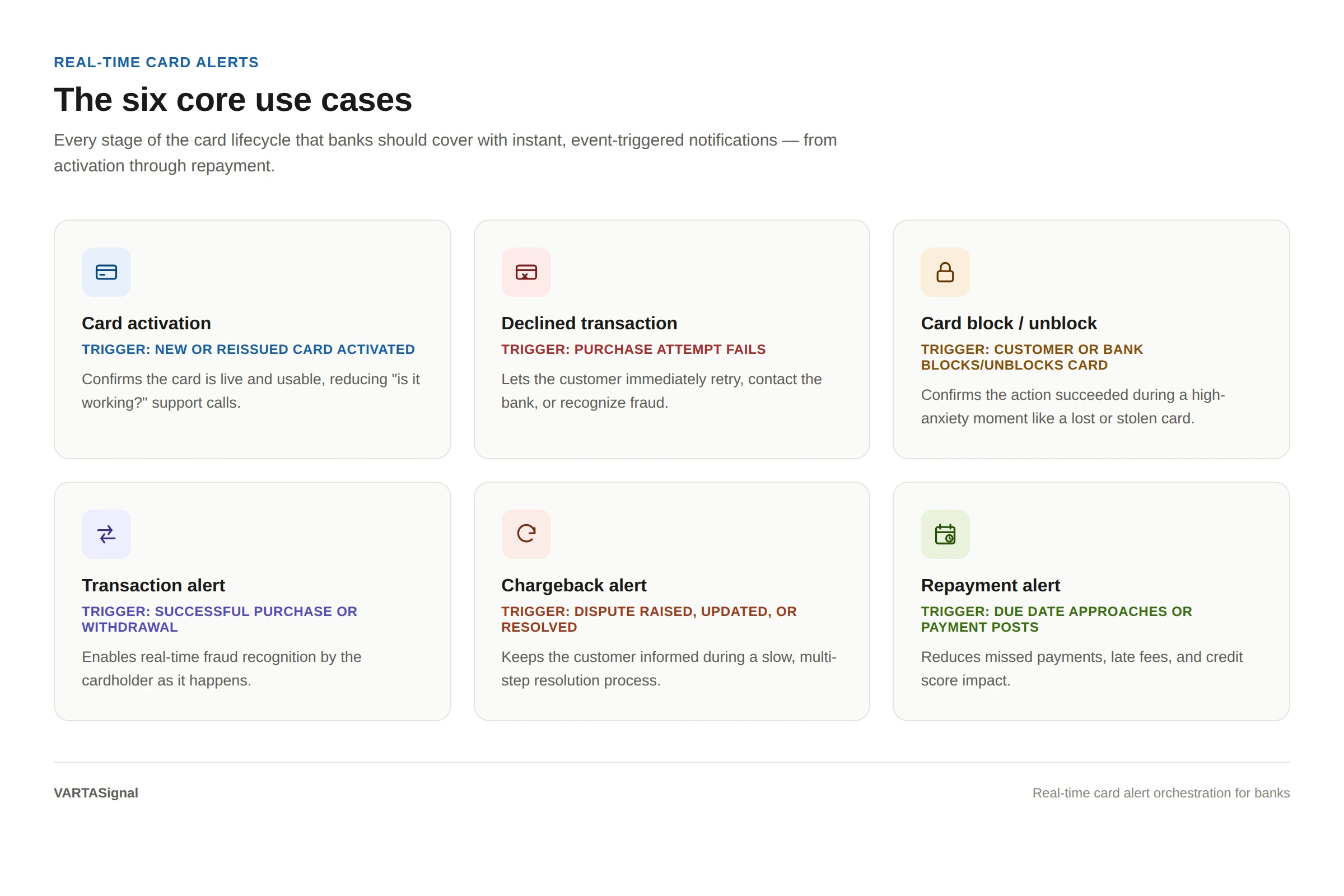
- Real-time card alerts cover six core moments in the card lifecycle: activation, decline, block/unblock, transaction, chargeback, and repayment.
- Relying on a single channel (typically SMS) creates delivery gaps; banks need multi-channel orchestration with fallback routing.
- A resilient alert layer needs five components: event capture, routing logic, channel fallback, a monitoring dashboard, and audit trails.
- Banks should track delivery success rate, latency, and fallback success rate — not just “message sent” counts.
- VARTASignal is positioned as an orchestration layer that manages which alert goes out, through which channel, with what fallback, and with what proof.
What Are Real-Time Card Alerts?
Real-time card alerts are automated notifications triggered the moment a defined event occurs on a customer’s card account. Unlike batch or delayed communication, they fire within seconds of the triggering event – a swipe, a decline, a block request – so the customer’s awareness matches the actual state of their card in real time.
They differ from generic marketing notifications in one key way: real-time card alerts are transactional and often security- or money-critical, which means delivery reliability, not just delivery volume, is the priority.
The Six Core Use Cases (Infographic)
Why One Channel Is No Longer Enough
Most banks started with SMS as the default channel for urgent alerts, and SMS still matters. But single-channel alerting has structural weaknesses: delivery performance varies by telecom carrier, geography, device state, and even time of day. When SMS fails silently, banks often have no fallback and no visibility that the customer was never actually informed.
| Single-Channel (SMS-only) | Multi-Channel Orchestration | |
|---|---|---|
| Delivery visibility | Limited – “sent” ≠ “delivered” | Tracked per channel, per gateway |
| Failure handling | None – message is lost | Automatic fallback (e.g., SMS → push → email) |
| Cost control | Fixed per-message cost regardless of relevance | Routes low-cost channels first, escalates only when needed |
| Audit trail | Minimal | Full timestamped routing history |
| Customer reach | Fails if customer has no signal/SIM issue | Reaches customer via app, email, or WhatsApp instead |
What a Resilient Alert Layer Needs
A dependable card-alert system has five components:
- Event capture – ingests triggers from core banking, card management, payments, fraud monitoring, and CRM systems in real time.
- Routing logic – decides the channel based on message priority, customer consent, and channel availability.
- Fallback sequencing – reroutes automatically (for example, SMS to push to email) if the first channel doesn’t confirm delivery within a set time window.
- Monitoring dashboard – gives operations teams a live view of latency, failure rates, and anomalies across all channels.
- Audit trail – logs every message’s trigger time, routing path, and delivery status for compliance and dispute evidence.
KPIs Banks Should Track
- Delivery success rate – percentage of alerts confirmed delivered, not just sent
- Average delivery latency – time from trigger event to customer receipt
- Failed-message rate – alerts that never reached the customer on any channel
- Fallback success rate – how often a secondary channel rescued a failed primary attempt
- Channel- and gateway-wise performance – which routes are reliable and which are degrading
- Complaint volume linked to alerts – customer complaints traceable to missed or delayed notifications
- Audit availability – percentage of alerts with a complete, retrievable audit trail
These metrics tie communication reliability directly to fraud loss prevention, support cost, and regulatory readiness – not just customer experience.
How VARTASignal Supports This
VARTASignal is built as a real-time alert orchestration layer for banking’s most critical, time-sensitive communication. For card use cases specifically, it provides:
- Multi-channel routing across SMS, push, email, WhatsApp, RCS, and in-app inbox
- Automatic fallback when a primary channel fails or is delayed
- A command-center view of delivery performance across all gateways
- Timestamped, audit-ready records for every alert triggered
Rather than functioning as a simple messaging tool, VARTASignal acts as a control layer that governs which alert goes out, through which channel, by which route, with what fallback, and with what proof – across the full card lifecycle from activation to repayment.
Conclusion
For cardholders, an alert is the transaction as far as trust is concerned – a delayed or missing message makes even a successful transaction feel unreliable. Banks that treat card alerts as core infrastructure, rather than a bolt-on messaging feature, get fewer support calls, faster fraud response, and stronger audit evidence. Real-time card alerts, delivered through an orchestrated, multi-channel layer like VARTASignal, turn routine card events into consistent, provable moments of customer trust.
See how VARTASignal can strengthen your bank’s cardholder alerting – [request a walkthrough].