


 Banking
 Insurance
 Credit Unions


 Professional Services
 Consulting & Advisory
 Legacy Migration

 Insights
 Whitepapers
 FAQs
FAQs Brochures
 E-Books
 Glossary
  Case Studies
 Events & News
 About Us
 Information Security
 FCI Cares
 Leadership
 Careers
 Partner Program
 Current Openings

A delivery audit trail is a time-stamped, tamper-evident record showing when a bank’s message was triggered, how it was routed, which channels and gateways carried it, and whether it reached the customer. For regulated notices, KYC communications, legal notices and internal reviews, audit trails turn “we sent it” into verifiable proof of delivery.
Banks that centralize this in an alert orchestration layer gain reliability, real-time delivery visibility, fallback routing and audit-ready evidence across every customer journey.

Key takeaways:
- Regulators and internal auditors increasingly ask for evidence of delivery, not just evidence of dispatch.
- A complete audit trail records the trigger event, timestamp, routing path, channel, gateway, delivery status and any fallback attempts.
- Single-channel alerting creates evidence gaps; orchestrated multi-channel delivery closes them.
- Delivery KPIs – success rate, latency, fallback success, audit availability – are compliance metrics, not just operational ones.
- VARTASignal acts as a control layer that generates audit trails automatically as messages move through banking journeys.
What Is a Delivery Audit Trail in Banking Communication?
A delivery audit trail is the end-to-end record of a message’s life: the event that triggered it, the exact timestamp at each stage, the routing decisions applied, the channel and gateway used, the delivery status returned, and any fallback or retry that followed.
In banking communication, this record becomes evidence – the difference between claiming a compliance notice was sent and proving it was delivered.
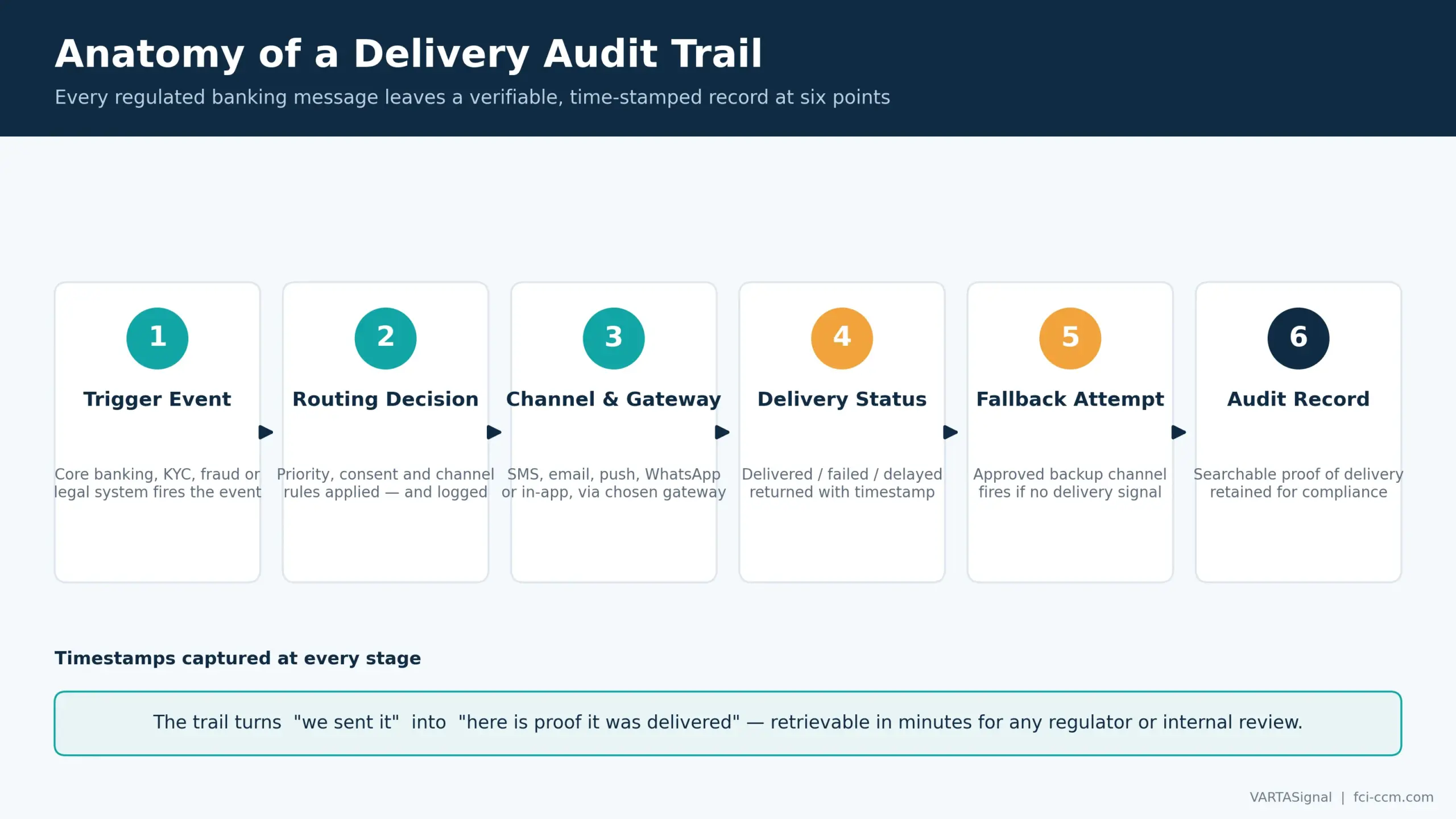
In banking, a message is rarely just a message. An OTP decides whether a customer completes a login. A payment confirmation decides whether a customer trusts a transfer. A regulatory notice decides whether the bank can demonstrate compliance when questioned. This is why delivery audit trails are becoming part of core digital banking infrastructure rather than a reporting afterthought.
For many banks, alerts still pass through fragmented systems, channel-specific vendors, manual escalation paths and limited reporting. That may be tolerable for low-risk communication, but it breaks down when the message is tied to money movement, identity verification, fraud risk, service assurance or regulatory evidence.
Customers expect instant clarity. Operations teams need visibility. Compliance teams need proof. Technology teams need routing control. A delivery audit trail is the single artifact that serves all four.
Why Delivery Audit Trails Matter for Regulated Banking Communication
Banks now operate in real-time customer environments.
Payments settle instantly, card transactions are authorized in seconds, and onboarding journeys move across mobile, web, branch, call center and relationship-manager touchpoints.
When communication is delayed, unverifiable or unclear, both the customer experience and the compliance posture break at the same time.
Regulatory and compliance communication raises the stakes further. Consider what happens without an audit trail:
- A customer disputes ever receiving a mandated disclosure, and the bank can only show that a message was queued, not delivered.
- An internal review of a KYC re-verification campaign cannot reconstruct which customers were reached, through which channel, and when.
- A legal notice sent before an account action becomes contestable because there is no timestamped delivery status.
- A regulator asks for delivery evidence across a notification category, and the bank must stitch reports from three vendors with inconsistent formats.
Even when the underlying banking transaction succeeds, unverifiable communication creates avoidable support calls, repeated customer attempts, failed journeys, reconciliation issues and – most costly of all – an evidence gap during an audit.
The Core Use Case: Proof of Delivery for Regulated Notices, KYC and Legal Communications
The highest-value application of delivery audit trails sits at the intersection of customer trust, operational efficiency and risk control:
- Regulated notices. Interest-rate changes, fee revisions, terms updates and account-status notices often carry mandated delivery obligations. An audit trail records the trigger, timestamp, routing path and delivery status for each notice, giving compliance teams retrievable proof rather than reconstructed logs.
- KYC communications. Re-KYC reminders, document-request messages and verification confirmations are frequent audit targets. A delivery record per customer, per attempt, per channel lets the bank demonstrate that outreach obligations were met before any account restriction was applied.
- Legal notices. When a communication precedes enforcement – recovery notices, closure warnings, dispute responses – its delivery evidence must survive scrutiny. Timestamped, tamper-evident trails make these communications defensible.
- Internal reviews. Risk, audit and operations teams use the same trails to reconstruct incidents: which alerts fired during an outage, where routing failed, how quickly fallback engaged and which customers were affected.
The operating principle:- If the first channel fails, the bank should have a fallback. If a gateway slows down, the bank should reroute. And whenever a regulator or auditor asks, the bank should be able to show when the message was triggered, how it was routed, and whether it was delivered – in minutes, not weeks.
Why One-Channel Alerting Is No Longer Enough
Many banks began with SMS as the default channel for urgent alerts. SMS remains important, but relying on a single route creates both a reliability risk and an evidence risk. Delivery performance varies by gateway, geography, telecom network, message category, time of day and customer device state.
A single-channel failure means both a missed customer moment and a hole in the compliance record.
For critical journeys, banks need a multi-channel strategy spanning SMS, email, push notifications, WhatsApp, RCS, in-app messages, internet-banking inboxes and personalized URLs.
The goal is not to blast every channel for every message. The goal is to choose the right channel, monitor delivery status in real time, and apply fallback rules when a delivery signal does not arrive – while logging every step.
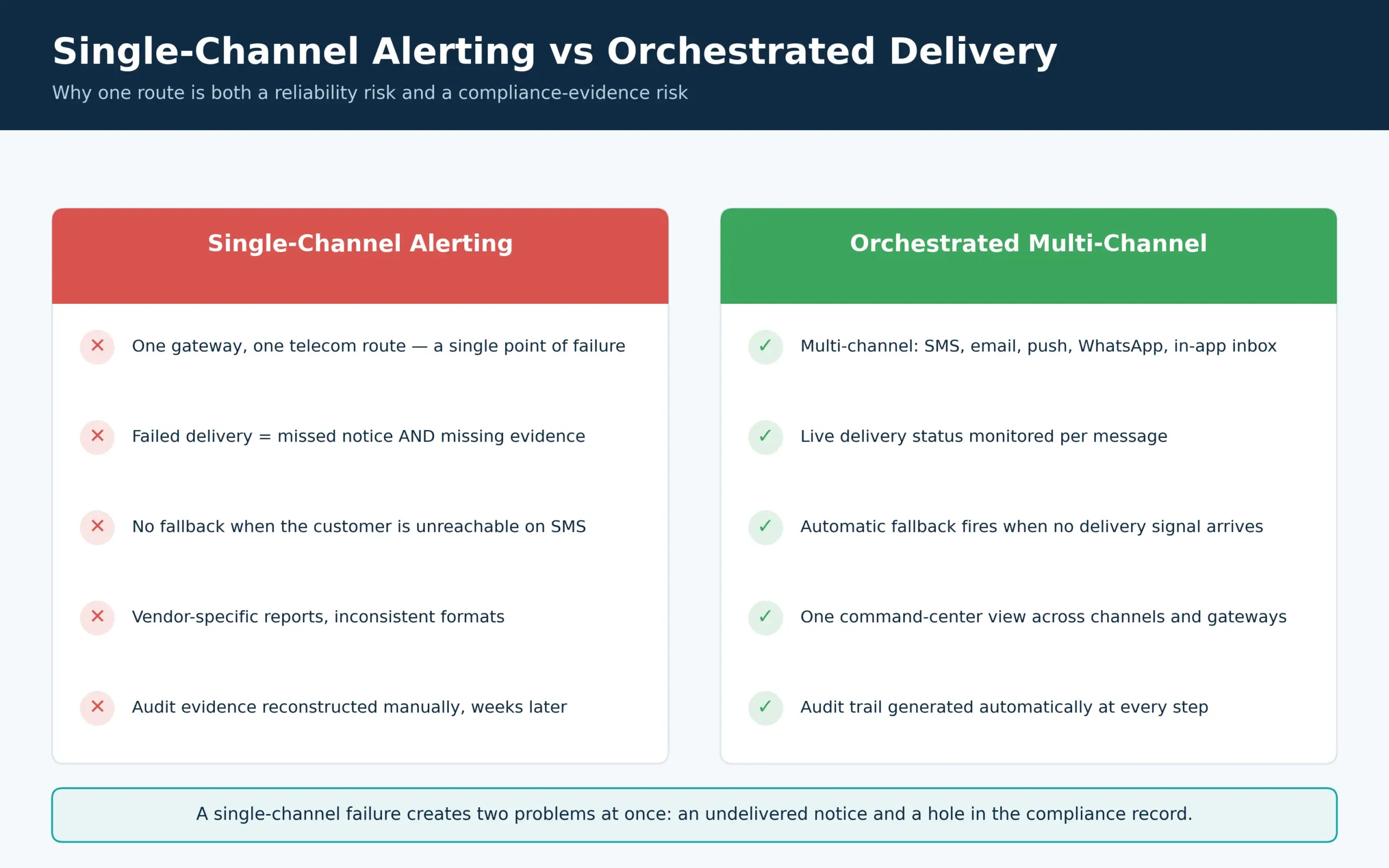
This is where orchestration becomes essential. The bank defines which events are critical, which channels are approved for each compliance notice category, which fallback sequence is allowed, what latency threshold triggers rerouting, and what evidence must be captured for audit. The audit trail is then generated as a by-product of correct operation, not assembled afterward.
What a Compliance-Ready Notification Layer Should Include
A resilient, audit-ready alerting layer needs five capabilities:
- Event capture from core banking, cards, payments, CRM, loan origination, fraud monitoring, digital channels and service platforms – so every regulated communication has a recorded trigger.
- Routing logic based on message type, priority, customer preference, consent, channel availability and live delivery performance.
- Fallback orchestration across approved channels and gateways, with each attempt and outcome logged.
- A command-center view for operations teams to track latency, failures, anomalies and delivery trends in real time.
- Audit trails with timestamps, routing path, delivery status and retention aligned to regulatory record-keeping requirements – searchable by customer, message category, campaign or time window.
Together, these move a bank from reactive communication management to proactive alert assurance. Instead of discovering problems after customers complain – or after an auditor asks – the bank monitors the health and evidentiary completeness of its communication flows continuously.
Business and Compliance Impact
The measurable outcomes banks typically target with delivery audit trails include faster audit response (evidence retrieved in minutes instead of multi-team reconstruction), reduced dispute exposure on legal and regulated notices, improved digital journey completion, fewer alert-related service calls, stronger vendor governance through gateway-level performance data, and higher customer confidence in critical journeys.
Audit trails also become a diagnostic asset. A spike in failed alerts can signal a gateway issue. Rising confirmation latency can expose a routing problem. Repeated alerts within one journey can indicate customer confusion. Compliance data, read this way, improves the underlying product experience.
KPIs Banks Should Track for Delivery Assurance (Infographic)
Treat these as compliance metrics with direct links to revenue protection and risk reduction, not soft operational stats.
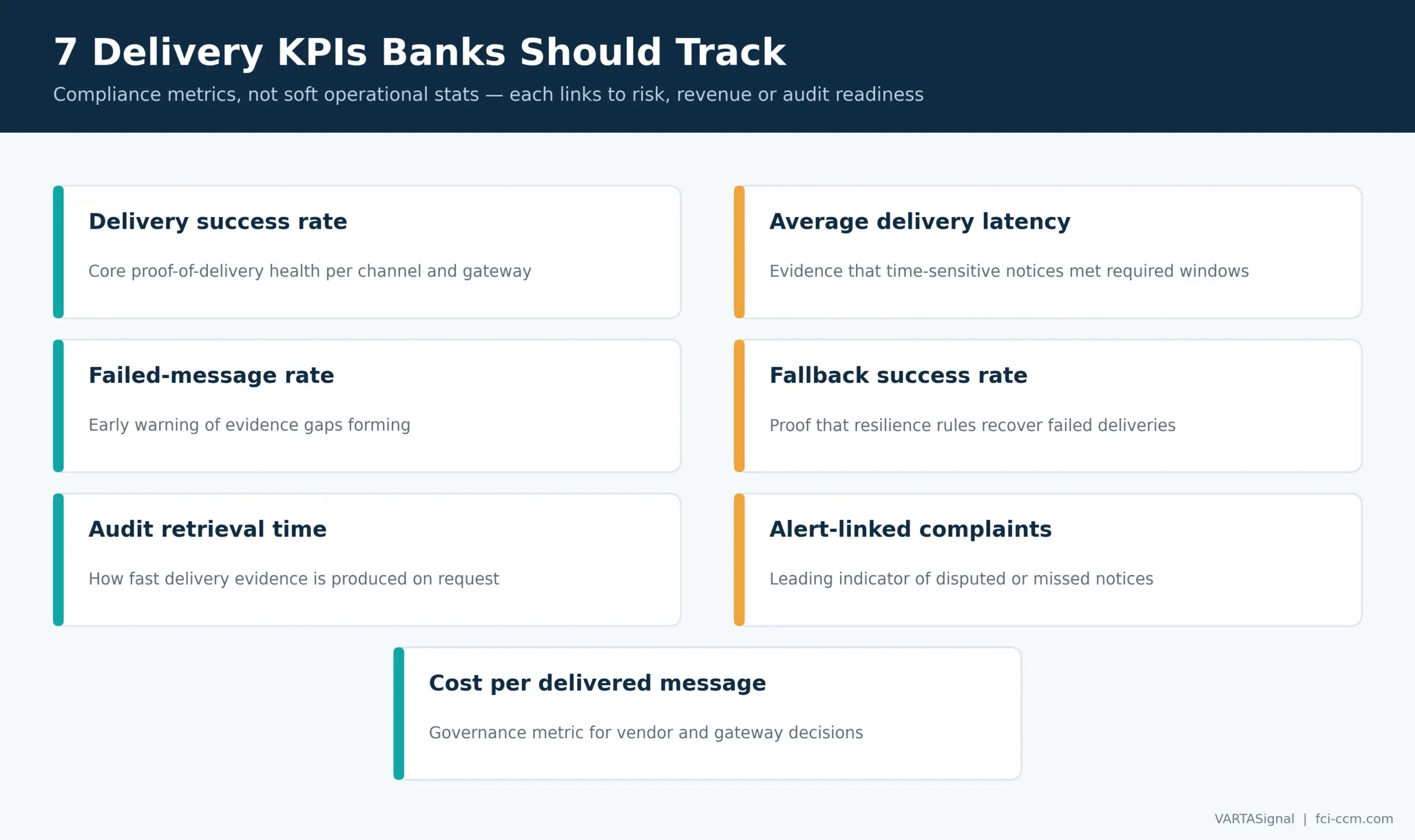
For fraud, payments and authentication use cases, banks may additionally track transaction completion rate, customer response time and escalation reduction.
How VARTASignal Supports Compliance-Ready Communication
VARTASignal is a real-time banking alert orchestration layer for mission-critical communication. It is built for exactly the scenarios above: delivery tracking with timestamps and routing paths, multi-channel routing with fallback, gateway flexibility, real-time monitoring, anomaly detection and audit-ready reporting.
Rather than a simple messaging tool, VARTASignal operates as a control layer for critical customer and operational communication. It governs what message goes out, through which channel, by which route, with what fallback – and with what proof. Every regulated notice, KYC communication and legal notice carries its own delivery audit trail from the moment it is triggered, so compliance evidence exists by design rather than by reconstruction.
Conclusion
Banking communication has become part of the trust infrastructure of financial services. Customers do not separate a transaction from the message that confirms, explains or protects it – and regulators do not separate an obligation from the evidence that it was met. When an alert is delayed, missing or unverifiable, the bank looks unreliable to the customer and exposed to the auditor.
That is why banks need more than channel delivery. They need orchestration, monitoring, fallback and evidence in a single layer. With VARTASignal, banks can strengthen the reliability of critical alerts and build a communication foundation that supports digital growth, risk control and demonstrable compliance.
Strengthen compliance visibility with VARTASignal. Request a demo.