


 Banking
 Insurance
 Credit Unions


 Professional Services
 Consulting & Advisory
 Legacy Migration

 Insights
 Whitepapers
 FAQs
FAQs Brochures
 E-Books
 Glossary
  Case Studies
 Events & News
 About Us
 Information Security
 FCI Cares
 Leadership
 Careers
 Partner Program
 Current Openings

Convenience is now the baseline in banking. See why Gen Z and MSME loyalty depends on insight-led engagement, not just digital experience.
In banking, every customer interaction now carries an expectation. Customers want their bank to recognize context, anticipate intent, and act before they must ask.

Two very different customer groups, Gen Z consumers and MSMEs, are proving this fastest. Gen Z has stopped rewarding app design alone. MSMEs have stopped tolerating generic outreach. Both groups are pointing banks toward the same strategic gap: communication built for context, not campaign cadence.
 Why Isn’t a Great App Enough for Gen Z Anymore?
A seamless mobile app no longer creates loyalty. It only earns the right to compete. Digital experience has moved from advantage to baseline expectation, and the numbers back this up.
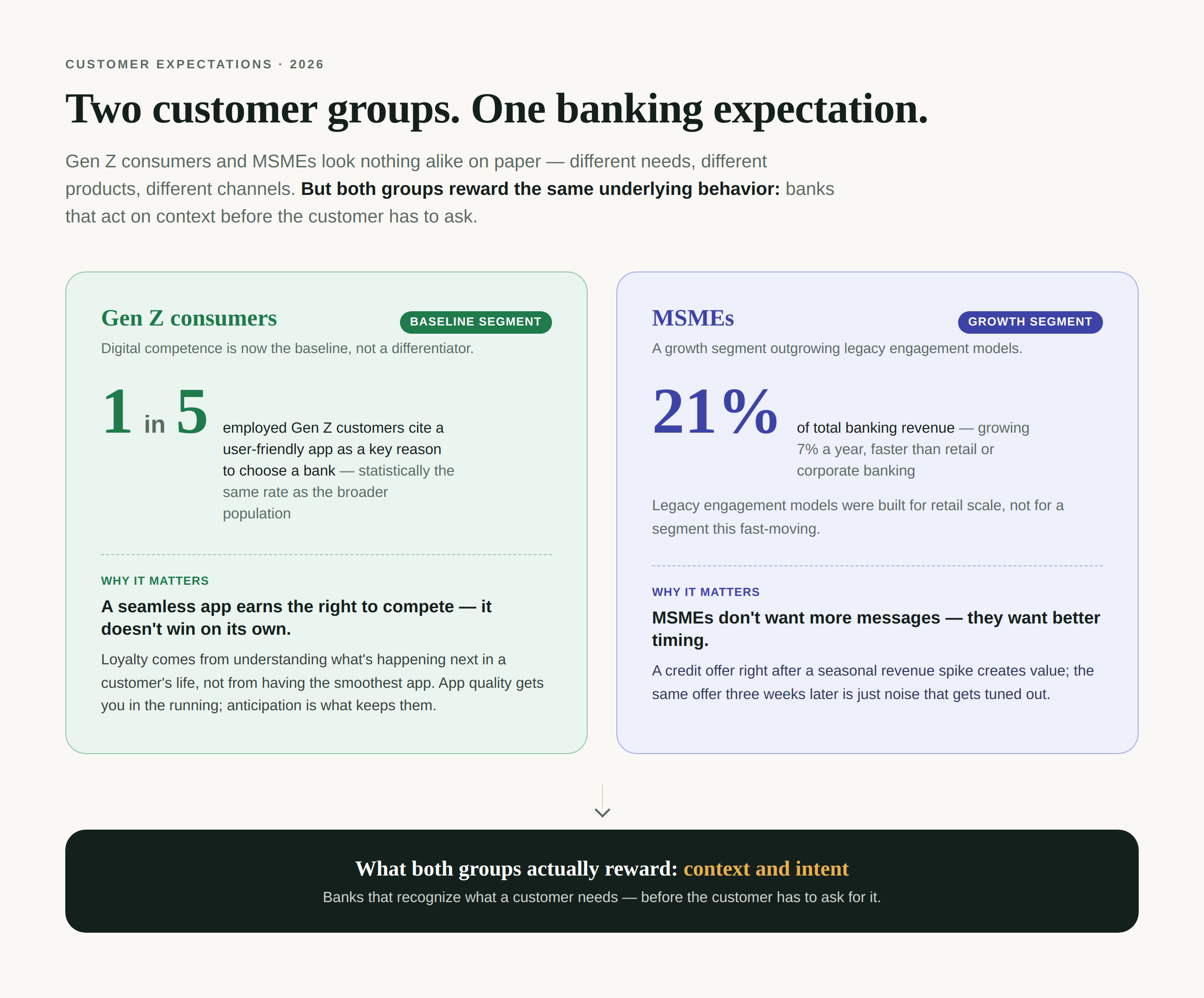
Only 1 in 5 employed Gen Z consumers name a user-friendly app as a key factor in choosing a bank. That is statistically the same share of the broader population. App quality has stopped being a differentiator for any generation, Gen Z included.
So, what earns loyalty? Whether the bank understands what is happening next in the customer’s life.
That is likely why fintechs like Cash App and Chime outperform traditional banks specifically among Gen Z, despite offering comparable digital functionality. The gap is not the interface. It is whether the institution reads customer context and responds to it, instead of simply hosting the transaction.
Why Are MSMEs Outgrowing Traditional Bank Engagement?
MSMEs sit in a completely different financial journey than Gen Z consumers. Yet they reward the exact same capability: banks that notice changing circumstances before being asked.
MSMEs generate 21% of total banking revenue and are growing 7% a year, faster than retail or corporate banking. Despite that growth, most banks still serve this segment through outdated distribution models and generic, one-size-fits-all outreach.
Here is the thing about MSMEs: they do not want more messages. They want better timing. A credit offer that arrives right after a seasonal revenue spike creates real value. The same offer sent three weeks later just becomes noise.
Closing this gap takes more than better products. It requires reading intent through transactional and behavioral signals, cash flow timing, credit utilization, and seasonal revenue shifts, then translating that recognition into timely, relevant engagement at scale.
What Should Banking Leaders Do Next?
Communication strategy needs a direct audit against customer context, not campaign calendars. A few practical steps worth reviewing:
- Evaluate whether your communication strategy optimizes for customer context rather than campaign cadence.
- Identify the behavioral and transactional signals that precede churn, product expansion, or financial stress.
- Measure whether your communication architecture can turn real-time insight into coordinated action across every channel.
- Benchmark your institution against an Insight-Led Communications maturity model.
Why Has Conversation Moved Beyond Personalization?
Gen Z and MSMEs surface this shift fastest, but the underlying expectation reaches every customer relationship: to be understood in the moment, not just served at the counter.
Personalization is already expected, so it is no longer the differentiator. The next competitive advantage lies in knowing when, why, and how to engage, before the customer must ask.
Delivering that level of engagement takes more than AI or modern channels alone. It takes an orchestration layer that translates behavioral and transactional signals into timely customer interactions at scale the operational foundation of Insight-Led Banking Communications.