


 Banking
 Insurance
 Credit Unions


 Professional Services
 Consulting & Advisory
 Legacy Migration

 Insights
 Whitepapers
 FAQs
FAQs Brochures
 E-Books
 Glossary
  Case Studies
 Events & News
 About Us
 Information Security
 FCI Cares
 Leadership
 Careers
 Partner Program
 Current Openings

Next-best action in banking is the practice of using real-time customer signals – transactions, logins, service requests, product milestones – to recommend the single most relevant action for each customer: the right offer, the right message, the right channel, at the right moment. It replaces static, calendar-based campaigns with intent-driven, consent-aware engagement that banks can measure in conversions, retention, and revenue.
TL;DR – Key Takeaways
- Banks already have the data. What’s missing is timely, personalized action on that data.
- Next-best action (NBA) engines convert raw signals – salary credits, loan drop-offs, dormant accounts, card declines, deposit maturities – into a single recommended action per customer.
- Effective NBA requires four stages: unify → interpret → recommend → measure.
- Personalization must be coordinated across channels and consent-first to build trust in a regulated industry.
- Modern Platforms operationalize this as micro-segmentation, real-time recommendations, multichannel orchestration, and closed-loop learning.

What is Next-Best Action in Banking?
In banking, Next Best Action (NBA) is an AI-powered decisioning framework that identifies the most relevant and valuable action for each customer at a specific point in time. Instead of relying on fixed marketing campaigns or predefined schedules, it leverages real-time data and analytics to deliver highly personalized recommendations across sales, customer service, risk management, and customer retention.
It is the discipline of deciding, for each customer, what should happen next – not what happened last quarter. Unlike dashboards or segment reports, which describe the past, next-best action systems are built to act while the moment is still relevant. In banking specifically, this matters because products are complex, regulated, and lifecycle-driven – customers often don’t know their own next step, even when the bank has enough signal to guide them.
Why Static Campaigns Are Losing Ground
A customer moment can appear and disappear within hours:
| Signal | What It Might Mean | Window to Act |
|---|---|---|
| Salary credit | Fresh liquidity, savings/investment opportunity | Hours |
| Loan application drop-off | Hesitation or missing documents | 24-48 hours |
| Dormant account activity | Reactivation or churn risk | Days |
| Card decline | Service friction, potential churn | Immediate |
| Deposit maturity approaching | Retention opportunity | Days to weeks |
If a bank responds to these moments days later with a generic, batch-and-blast campaign, the opportunity is often already gone. This is the core limitation next-best action engines are designed to solve – and it’s the primary reason cross-sell and upsell conversion rates stall even when banks have rich customer data.
From Data to Decision: The Four-Stage Model
A practical customer intelligence model for banking connects four stages:
1. Unify
Bring together signals from core banking, CRM, cards, loans, digital channels, service platforms, campaign tools, and customer data platforms (CDPs).
2. Interpret
Apply rules, models, customer profiles, and behavioral patterns to understand intent – not just activity.
3. Recommend
Trigger the next-best action based on eligibility, intent strength, customer value, risk, consent status, and channel preference.
4. Measure
Feed outcomes – accepted, ignored, converted, opted out – back into the model so every subsequent recommendation gets smarter.
This closed loop is what separates a customer intelligence layer from a traditional campaign management tool. Data only becomes valuable when it drives a specific, timely, measurable action.
Coordinated Personalization Across Channels
Personalization in banking has to be coordinated, not noisy. A few rules of thumb:
- A customer who just filed a complaint shouldn’t receive an unrelated cross-sell offer.
- An RM shouldn’t call about something the customer already resolved through the app.
- A campaign should stop the moment a customer converts or opts out.
This requires multichannel orchestration – SMS, email, WhatsApp, app notifications, contact center prompts, and RM task queues all working from the same source of truth. The goal: the right message, through the right channel, at the right moment, with explicit consent and full context.
For regulated financial institutions, this also means personalization has to be trust-aware – respecting consent, channel preference, eligibility, product suitability, and communication governance. More messages isn’t the goal. More relevant messages, that the bank can defend to a regulator, is.
Business Impact: Why This Drives Revenue Growth
Banks adopting next-best action strategies typically see improvements across several levers:
- Higher offer conversion and cross-sell relevance
- Lower drop-off during onboarding and loan journeys
- Improved deposit retention at maturity
- Faster reactivation of dormant customers
- Stronger RM productivity through prioritized, contextual tasks
- Reduced campaign wastage and clearer ROI attribution
The underlying value driver is simple: recognizing intent before it becomes a lost opportunity. If a customer is ready to borrow, save, invest, renew, or reactivate, the bank should be positioned to respond with context – not three weeks later with a generic flyer.
Key Performing Indicators To Track
| Category | Example KPIs |
|---|---|
| Conversion | Conversion rate, click-through rate, offer acceptance rate |
| Journey health | Journey completion rate, product uptake, drop-off rate |
| Retention | Churn reduction, dormant reactivation rate, deposit rollover rate |
| Operational | RM contact productivity, campaign cost per conversion |
| Financial | Incremental revenue, ROI per campaign |
| Governance | Consent adherence, channel preference compliance |
A mature intelligence layer also tracks what doesn’t work – ignored messages, repeated drop-offs, and channel opt-outs – because that negative signal improves the next recommendation just as much as a conversion does.
How VARTASense Supports the Next-Best Action (Infographic)
VARTASense is an AI-driven customer intelligence and engagement layer built for banks that need to move beyond broad segmentation and static campaigns toward real-time, persona-aware, measurable engagement.
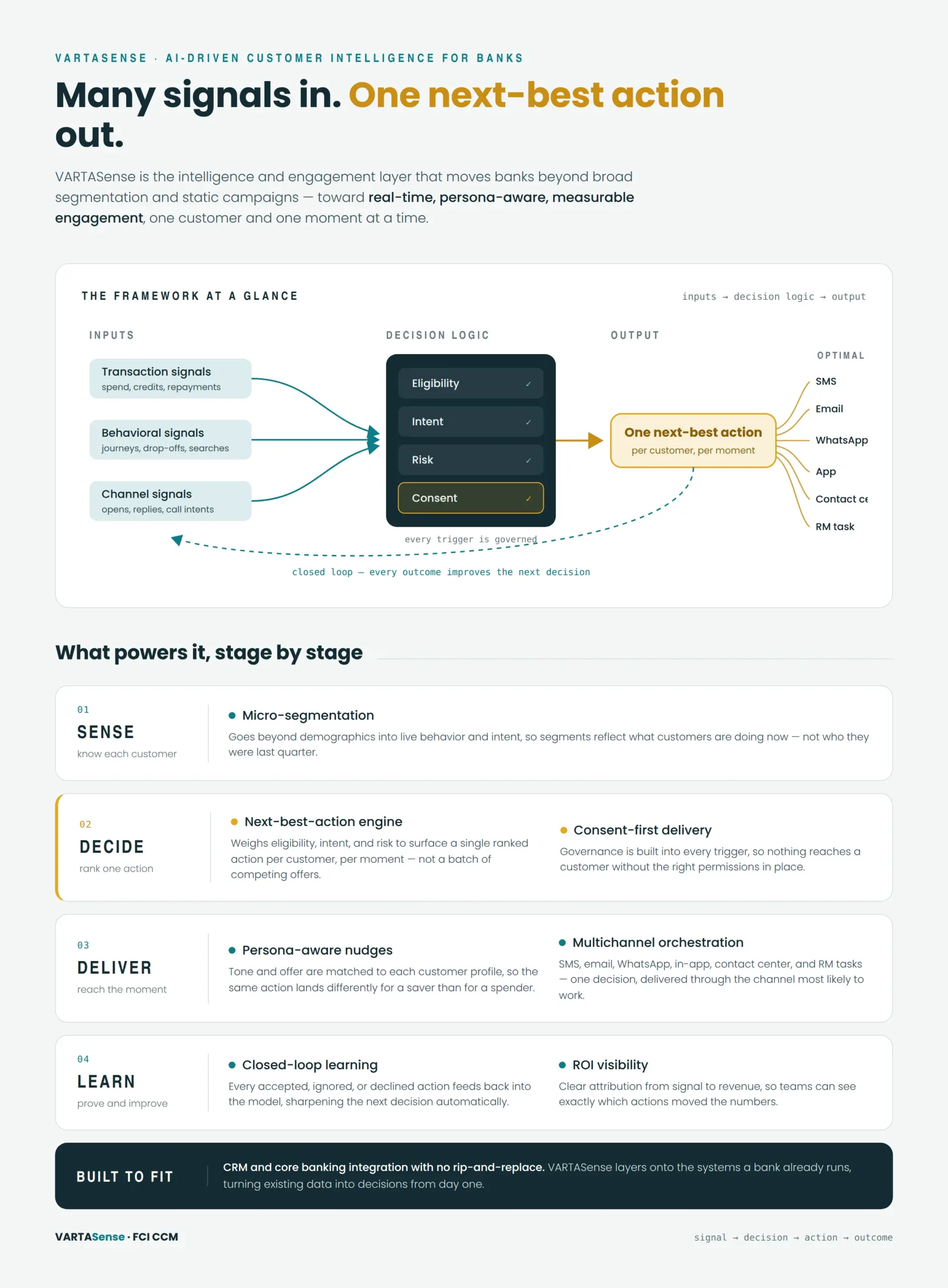
Framework: Inputs (transaction, behavioral, and channel signals) → Decision logic (eligibility, intent, risk, consent) → Output (a single next-best action, delivered through the optimal channel).
Conclusion
Banking growth is no longer only about acquiring new customers or running more campaigns – it’s about understanding existing customers better and acting at the right moment with genuine relevance.
AI-driven customer intelligence closes the gap between what a bank knows and what it does. With a platform like VARTASense, banks can move from dashboards to decisions, from segments to personalized journeys, and from campaign activity to measurable customer growth.